By Frankie Blake Greenslade
All Artwork photographed by Frankie Blake Greenslade
Yoshitomo Nara, the recent exhibition at the Hayward Gallery, is dedicated to the life-work of the contemporary Japanese artist. You are invited to explore his collection, with eight rooms filled with more than 150 works of drawing, painting, sculpture, installation, and ceramics to sink your teeth into. According to the Hayward Gallery, this thematic exhibition reveals the “enduring influences on the artist’s work, particularly nature and its mythology, the peace movement, the significance of home, and his interest in punk and rock music and popular culture.” This exhibition expands upon shows previously held at the Guggenheim Museum Bilbao and the Museum Frieder Burda in Baden-Baden, with this retrospective acting as his first UK solo exhibition.
This charming exhibition begins with My Drawing Room (2008), a painted wooden architectural structure resembling the studio space in which Nara works. A large hand-painted sign lies on its exterior with the words “Place Like Home” in colourful block font. Inside the shack, drawings are scattered on the floor, some are half-finished, with toys lining his shelves and figurines dispersed across the desk, giving us an insight into the inner workings of his mind. It is a safe space, one filled with childlike wonder and imagination, placing his conceptual and formal processes at the forefront.

My Drawing Room (2008) and his record collection in the first room at the Hayward Gallery.
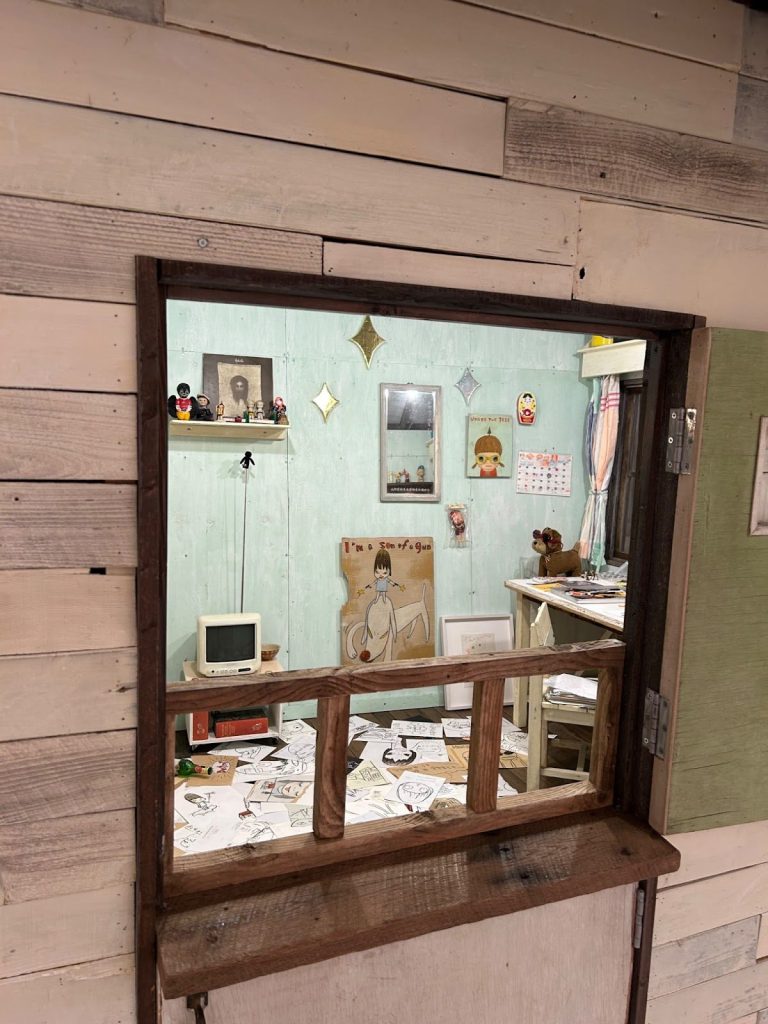
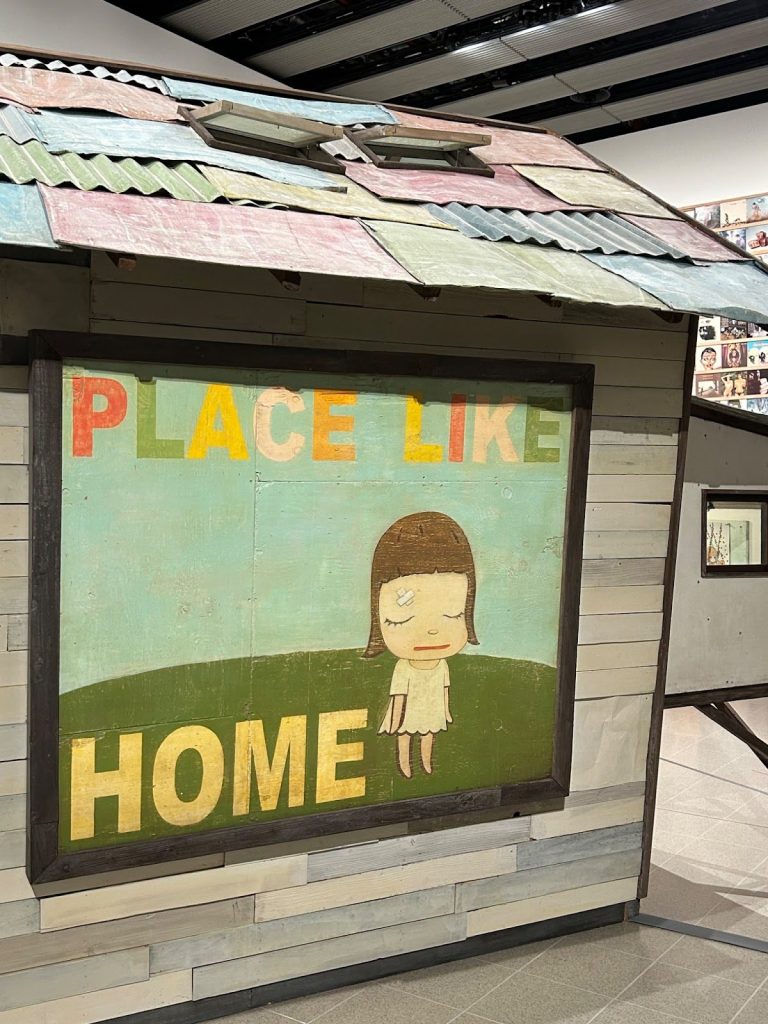
Musical references often feature in Nara’s work, showcased in the retrospective by a large wall displaying the record sleeves of his personal collection, mostly from the 60s and 70s, behind his personal shack. All of these punk and rock ‘n roll albums are said to have influenced his work, with his obsession with this music causing him to internalise an anti-establishment sentiment and sense of rebellion from a young age.
Nara’s childhood had a significant influence on his artwork. Born in 1959 in the small traditional castle town of Hirosaki, Nara grew up in the rapidly changing post-war Japan. The American-led occupation following World War II implemented a number of socio-economic reforms, including redefining societal roles and dismantling the nuclear-family unit. With both parents now at work and a significant age gap to his older siblings, Nara’s childhood was characterised by a sense of loneliness and isolation, further amplified when he moved to Germany in the 90s and dealt with a significant language-barrier. To cope with this, he turned to creating art and listening to music as a form of self-expression.
It was in the 1990s, as a graduate student in Germany, where Nara laid the foundation of his paintings we see today: the Nara bid-headed ‘girl’ characterised by her menacing wide-eyes, embodiment of ‘kawaii’ (cuteness), and emotional ambiguity. Nara was inspired by fellow Japanese artist Takashi Murakami’s “Super Flat” movement, exploring how collective trauma shaped Japan’s visual culture through bright palettes, cartoon styles, and critique on consumer culture. This big-headed girl has come to define his popularity, where her childlike expressions resonate with adult emotions, making his paintings both relatable and compelling. The striking expressions of the Nara ‘girl’ dances in the space between the cute and the arresting, with some explicitly loud and brash (Dead Flower 1994) whilst others more innocent until you read the name of the piece (Missing in Action 1999).
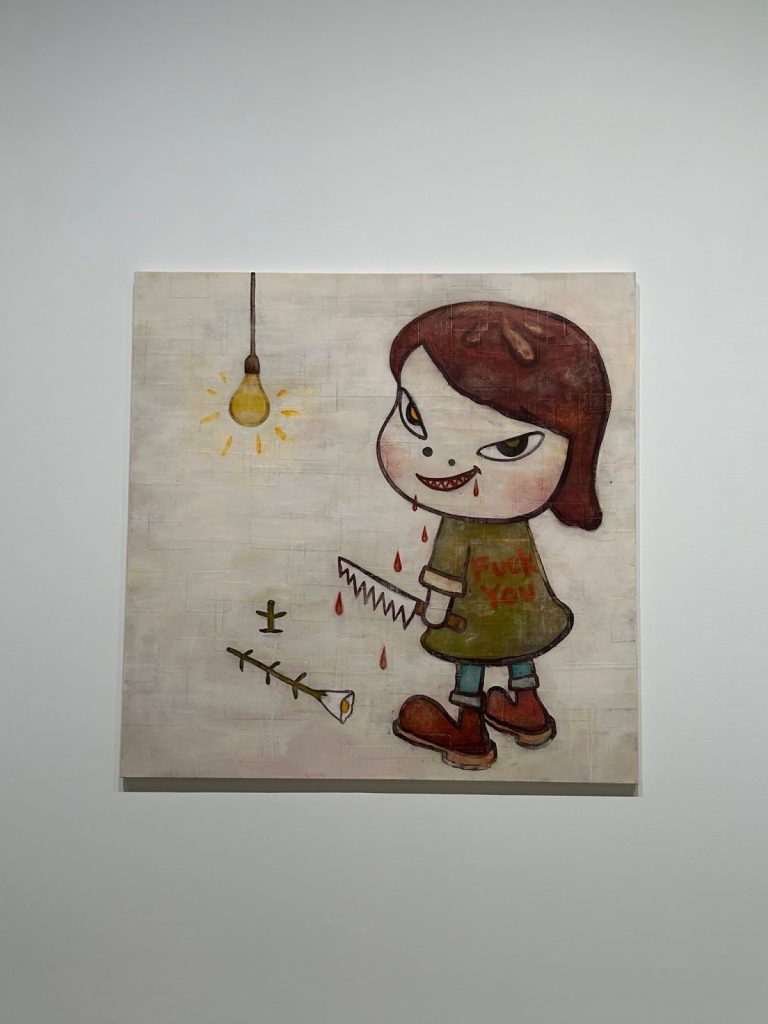
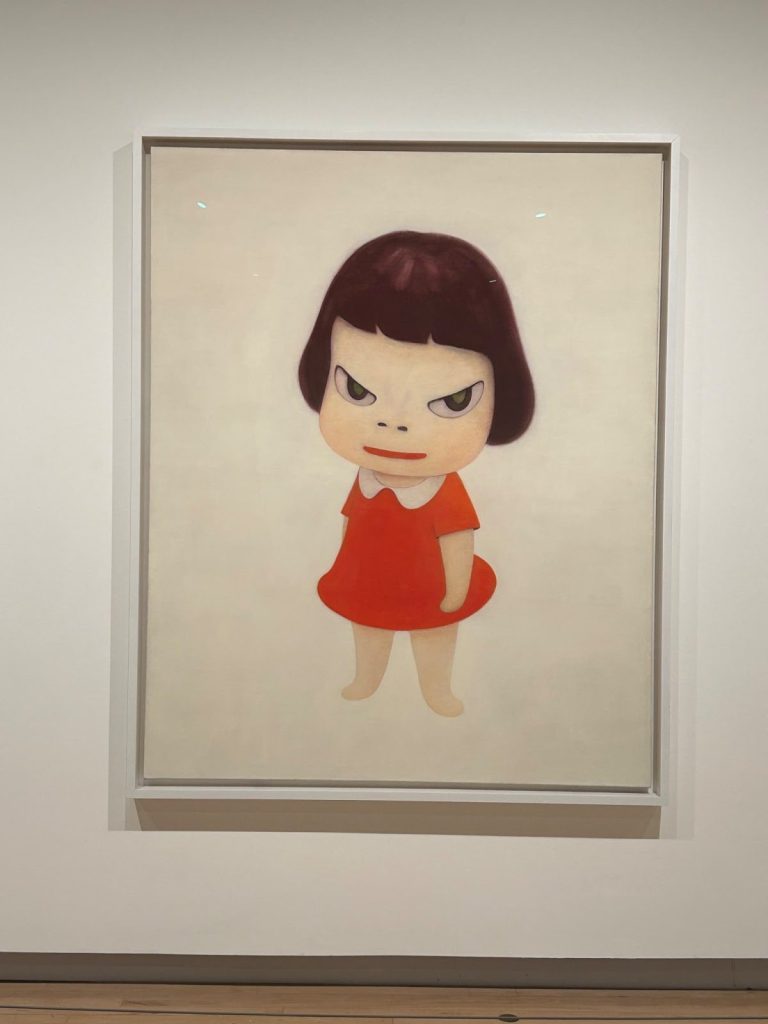
Dead Flower (1994) & Missing in Action (1999)
As you get further into the exhibition, there is a notable shift in the subject matter of his work following the devastation caused by the Fukushima Daiichi Nuclear Disaster in March 2011, an event which caused radioactive contamination of the surrounding area in Japan. This had a lasting impact on Nara, renewing his interest in humanitarian causes and centering an anti-war sentiment at the heart of his work. From the Bomb Shelter (2019) and Stop The Bombs (2011) are two key paintings which emerged from him becoming more politically vocal through his creative work. From the Bomb Shelter depicts a childlike character conveying the vulnerability and determination of the survivors of this disaster, and Stop The Bombs further conveys his pacifist perspective through the subject of the child. Nara wrote on his website: “Now, even in this very moment, there is a bomb exploding somewhere in the world […] But there must also be new life coming into the world in that moment. ‘STOP THE BOMBS!’ I feel this from the bottom of my heart.”

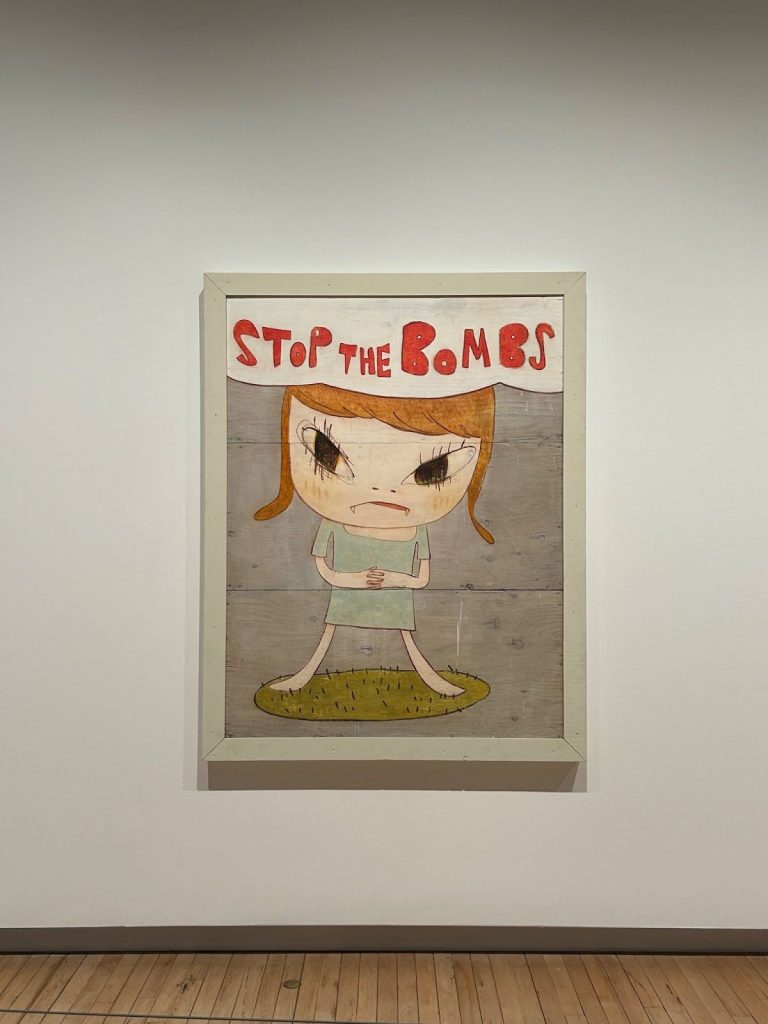
From the Bomb Shelter (2019) & Stop the Bombs (2011)
It is necessary to see beyond the ‘kawaii’ of these paintings to assess what sort of impact he has had on the contemporary art world. Yoshitomo Nara explores themes of resistance, rebellion, isolation, freedom and spirituality, all of which are timeless and universal. The exhibition at the Hayward Gallery does a good job of conveying his conviction that art needs to find emotional connection and generate empathy, appealing to the viewer’s feelings and allowing them to claim his art as their own. We are invited to kindly confront conflicting emotions, especially in terms of how we see childlike innocence and joy in times of war and conflict. Yoshitomo Nara has never been more relevant, and I would encourage you to go see the exhibition whilst you still can.
The Yoshitomo Nara exhibition at the Hayward Gallery in South Bank, London is on until 31 August 2025. Standard entry is £20. Members go free. Concessions available for full-time students, Lambeth residents, under-30s and recipients of Universal or Pension Credit, Tue – Fri & after 5pm on Sat.
 Surround Sound Magazine