By Amy Kilroy
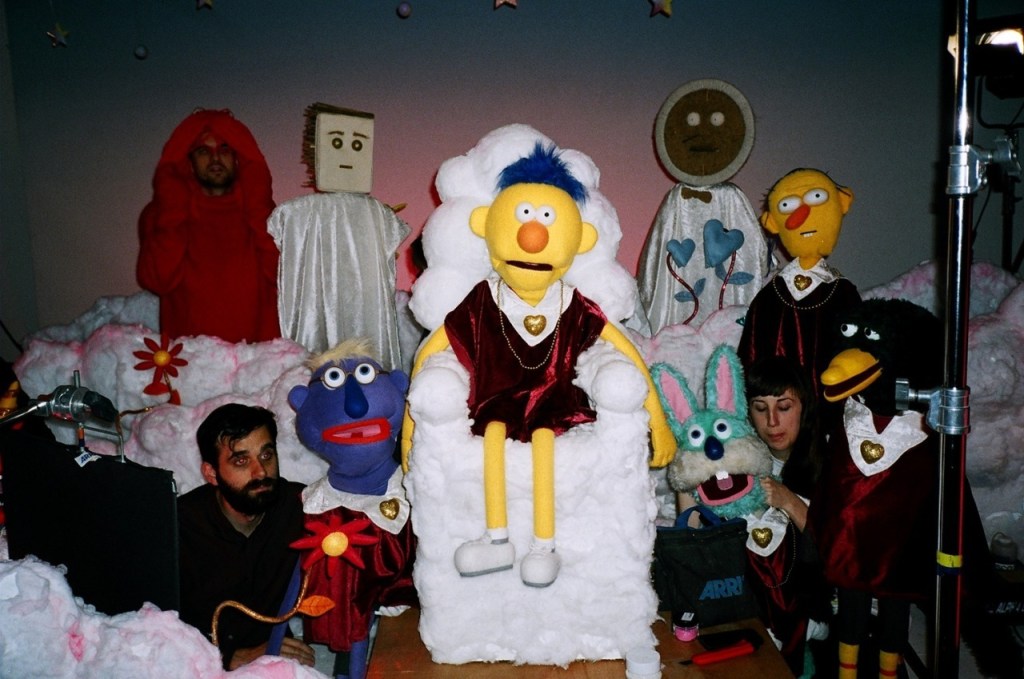
The position of the student writer in 2026 is a paradox with a deadline. Creativity, originality, and voice are still upheld as sacred values within academic and cultural discourse, yet artificial intelligence systems now generate essays, reviews, and opinion pieces in seconds. For student writers working voluntarily, often without pay or institutional authority, and hiding amongst algorithmic visibility, these contradictions raise an uncomfortable question: what does authorship mean when writing itself can be automated?
For me, this question manifests less as a cluster of personal executive dysfunctions – primarily: doom scrolling, pacing, and blasting music through my Air Pods like I am the subject of a manic, very low-budget montage. Even in these stalled moments, my creative mind refuses to fully power down.
Enter the connection I have drawn between my experience as a student writer and the universe of Don’t Hug Me I’m Scared (DHMIS)! Ultimately, its embrace of all things nonsensical – confusion, fragmentation, and discomfort – offers a critical lens through which to examine contemporary anxieties surrounding budding creatives particularly within student writing cultures. So now, and without further ado, please allow me to ramble my way into consistency and prove this personal head canon as pure-unabridged-matter-of-fact.
When asked how best to describe Don’t Hug Me I’m Scared to those unfamiliar with it, creator Joe Pelling describes it as “A kids’ show for adults” qualifying this by noting that the team avoids explanation wherever possible. Director, Baker Terry, pushes this further, explaining that they want viewers to be watching and thinking, and I quote: “What is this? What the fuck is this?”
Confusion then, is at the core of DHMIS’ design. Resisting stereotypical legibility, denying audiences the comfort of fixed meanings or stable interpretations, it’s a show that challenges a cultural landscape increasingly dominated by systems, including AI, that privilege clarity yet also predictability (arguably, the worst qualities to have in art).
The shows subtle resistance is especially resonant within the current AI zeitgeist popular with the Gen Z demographic. Artificial intelligence is engineered to minimise ambiguity, producing text that is statistically plausible, structurally sound, and broadly intelligible. DHMIS, by contrast, foregrounds uncertainty and demands that viewers actively engage and question the piece rather than consume passively, demanding it as a piece that encourages it’s viewers to remain reactive and visceral.
In short, it’s a vessel best explored in the margins of the unknown – a merit to which student writers, alike Joe and Becky when they started making the show, can empathise with.
First launched on YouTube in 2011 shortly after its creators graduated from art school, Don’t Hug Me I’m Scared emerged as a response to institutionalised creativity.The debut episode, centred on Duck, Red Guy, and Yellow Guy receiving a lesson on creativity, immediately establishes this tension where creativity is encouraged, but only within strict and often unspoken boundaries. The result is their creativity turning violent, leaving their teacher horrified at a mistaking of direction, ending the pilot on the remark: “Now, let’s all agree to never be creative again”.
Over a decade later, the series transitioned to Channel 4 as a full-length television production, launched on 23 September 2022 and produced by Blink Industries. While the scale expanded, the show’s commitment to confusion and critique remained intact. Greater temporal and spatial freedom did not lead to resolution or narrative closure, the ambiguous remaining crucial while plots simply became more abstract and complex – the budget, thus, changed no core intentions of the shows critical origins.
This trajectory in itself can be thought to mirror that of many student writers. Beginning on the margins and often producing work without remuneration or recognition, student creatives are encouraged to be original while simultaneously conforming to institutional expectations. Like DHMIS, their work exists in tension with systems that claim to nurture creativity while quietly regulating it.
One of the most striking aspects of Don’t Hug Me I’m Scared is its refusal to commit to a single creative mode. Across its iterations, the series combines live action, puppetry, claymation, stop motion, 2D animation, and CGI. The Channel 4 series continued this tradition at a larger scale. Producer Hugo Donkin describes production taking place in a large studio in Canada Water, with two live-action units, a stop-motion unit on the side-lines, and CG and 2D animation happening afterwards. This multiplicity foregrounds creative labour as collective, material, and time-intensive.
Perhaps the most recognisable element of Don’t Hug Me I’m Scared is its puppetry. What began as a practical necessity, “Back in the day, it was all of us doing the puppeteering,” Terry explains, has evolved into a deliberate aesthetic choice. Although the Channel 4 series employs highly skilled puppeteers, the creators are uninterested in conventional standards of technical perfection. “We’re not looking for what you would categorise as a good performance from a puppet,” Terry notes.
This embrace of imperfection is revealing. Puppets are expressive precisely because they are limited, awkward, and visibly constructed. Their movements resist the seamlessness associated with automation. AI-generated writing, by contrast, often appears smooth and internally consistent, yet lacks the acute friction, hesitation, and vulnerability that comes from the man-made
Frequently uneven, exploratory, and emotionally invested – student writing by no means is any different. These qualities are often framed as weaknesses within institutional contexts, yet they signal genuine intellectual engagement. Where universities create societies to promote this journalistic curiosity, AI excels at reproducing form without experience, coherence without consciousness and without the years of student debt looming over its head also.
In an educational and cultural environment increasingly shaped by automation, Don’t Hug Me I’m Scared simply serves as a reminder that confusion can be a productive stepping stool to simply create. DHMIS foregrounds excess, failure, and contradiction – voluntary student writers, this distinction is crucial. Writing is not simply the production of text but a process of thinking, questioning, and negotiating meaning. Authorship for students in these small voluntary roles thus act as a similar playground and set piece as the Dont Hug Me I’m Scared set acted for Becky and Joe upon developing their now-hit-series.
Don’t Hug Me I’m Scared ultimately refuses to explain itself, and that refusal is its most radical gesture. In a cultural moment obsessed with technological solutions, the show insists on the value of amateurish opacity. The vessels of great art are found in explorations of what we do and do not know ; after all, is it not this self-awareness that makes the arts meaningful in the first place?
In an era increasingly shaped by systems that promise to make creativity easier, Don’t Hug Me I’m Scared reminds us that meaningful authorship is rarely painless, and that confusion, far from being a flaw, may be the clearest sign that something real is being made.
So, whilst my comparison may be a stretch to others, it’s one that continuously inspires me to write messy, unclear and nonsensical- all that matters is that I perfect it later and get it made now (and as all student writers surely say: I’ll fix it later).
 Surround Sound Magazine
Leave a comment