By Jonah Briggs
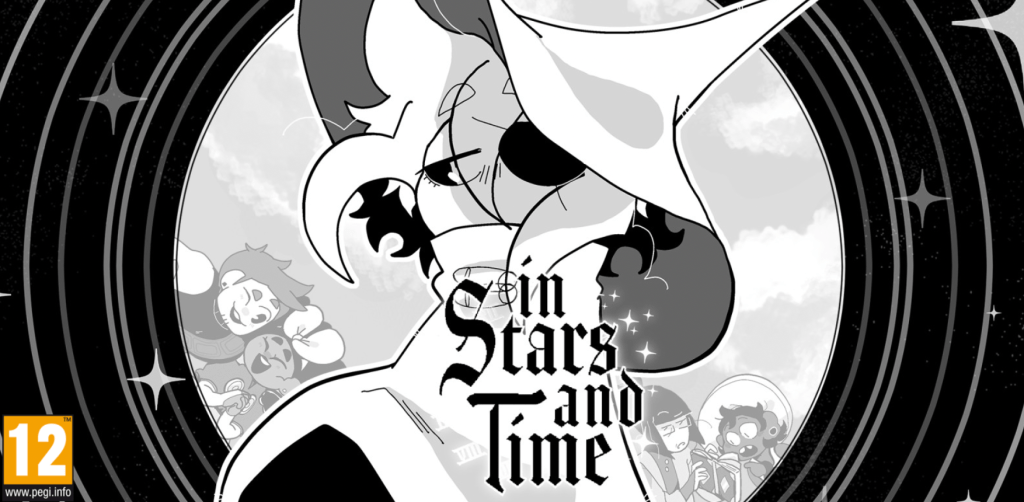
I had the pleasure of speaking to Adrienne Bazir (She/They), (@InsertDisc5 on all platforms) about being an indie dev, her past work and her game that is currently in development: Truth Scrapper.
Please note: There will be characters mentioned that are queer/gender fluid, so pronouns used to refer to them may be used interchangeably (e.g. Siffrin uses He/They).
For my first question I just wanted to ask: How has being an Indie Dev impacted the way you tell stories?
I’ve been telling stories for a long time, mostly through comics. That was my medium of choice. I would say that since I’ve started making video games, it taught me how to make longer stories. Comics are so long and have so many different parts, so they take so much time to make. With Video games, you might not know it, but they also take a long time to make. I [do] find that they are more conducive to telling longer stories, because with comics, you have to make one panel at a time. For video games you can make a couple of portraits, a framework and then after that you can just write. So I would say it really taught me to make longer stories. [Along with] that, I’ve always kept the reader or the player in mind, even with comics.
With the medium of video games, there’s this interaction between the game and the player and I really had to keep in mind how the player could react to something. In comics, it’s not important at all. You can take whatever you want from it. It doesn’t really matter. It’s there, It’s done. You just have to turn the page. But for a video game, you have to always keep in mind what the player might feel, think or expect. Ultimately, I think once you’re familiar with any [storytelling] format, all you have to do is tweak the points you take to get to your end.
As both a narrative and a gameplay choice, what draws you to time loops? Because it’s more literal in ISAT with you being reset to Dormont but with truth scrapper it’s more that the day’s progress [whilst Sosette is the one that resets].
To me, the real link between In Stars and Time (which will be referred to as ‘ISAT’ from here on) and Truth Scrapper isn’t time loops. It’s more about memories and who gets to remember. It’s about how those memories impact you or others in ways you might not realise right away. There’s an inherent drama in playing with the idea of “the keeper of knowledge” who knows some things whilst others are in the dark. I think those were some of my favorite parts of writing ISAT, those moments where Siffrin does not hide the [effects of the] time loop very well and people around him pick up on it.
And so that’s kind of the same thing with Truth Scrapper, where now you’re the one who is deciding: Should you remember this or that love interest? How is that going to impact the way that both of those characters relate to you? How do you play within that space of knowing and not knowing? I also haven’t even talked about the whole thing with Siffrin’s country which is [again] the loss of memory but also the loss of culture.
The ambiguity of his country is a really interesting choice, how do you feel having left an entire part of his identity out?
I appreciate the question! I’m always really interested about how people talk about that part of ISAT because when I feel cynical I go, “All right, this is so interesting that when people talk about ISAT and its themes, they mainly talk about queerness.”
And yeah, but I feel like the loss of culture is the most important thing here. I do find that interesting and it’s not necessarily a bad thing. It’s just interesting that people find [the theme of] queerness more important than the loss of culture [and everything associated with it]. I think it’s also that the fandom is a lot of white American queer people that don’t necessarily relate to this loss of culture, and why would they? That makes sense. But when people talk about that part of ISAT, I have taken specific things from within me to create that. I don’t want to get into it for many reasons, but yeah.
Most of my surprise is that I didn’t necessarily expect people to take [such] different things from it. A lot of people go “well, to me, this is really relating to my experience as someone of Asian or Polish or Irish descent” and I find that absolutely fascinating. I didn’t expect that so many people from so many different cultures would take something very specific from it and relate to it in this [way] of, this country and its culture are gone. What does that mean to certain people? To me, Siffrin lets go of it at the end of the game. [I wrote it as] “I’m trying to make my peace with it, it won’t come back and I need to continue living” and to me that is a positive thing. That doesn’t mean completely letting go and forgetting about it.
How do you feel that using loops impacts the way you depict characters, especially as the one who has spent the most time with Siffrin [and the rest of the cast]. How do you keep him interesting throughout so many loops?
I think the thing about loops like this when it comes to characters is that, as humans, we show one persona to most people but we are so much more than that. I feel like time loops are a really great way to have the character experiencing it realise that [other] people have feelings. That’s the thing overall. It’s like, “Oh my god, you said this thing the whole time”. But after enough loops, you realise that what you said offhandedly impacted someone in ways that you might not understand. And for Siffrin, even though they’re the one in the time loop, it’s a way [for them] to also dig deeper into themself.

I wanted to ask about how loops impact how you depict characters, specifically in regards to Truth Scrapper. We talked about that a bit already because you were talking about picking memories of the romantic interests that you’re going to keep. It’s kind of what you’ve said about Siffrin but in the opposite direction.
Yeah, I really liked writing Siffrin, their memories and their character. For Siffrin, it’s very important to know his history and where he’s from. There’s kind of this quest [running throughout] in going after that. For Sosotte, the first idea that I had when writing her is that I wanted her to be the reverse. Instead, it’s that Sosotte doesn’t care. “This is just how I am”. She has proof with her (in the form of her scrapbook) where she writes all her memories every day, but she has been in this situation for a very long time. She forgets everything every day, she touches her scrapbook again and she remembers everything that was written in it. Since she has the knowledge that this has been the case for a long time, [due to] reading what she’s written, she feels ok with it. Past her seems to have been pretty okay with it, so it’s very much “Well, I guess I’m okay with it too – I have no reason to think otherwise.”
I think we touched on themes of ISAT and Truth Scrapper briefly but I just wanted to ask directly: Are there any themes from ISAT that you wanted to explore more in Truth Scrapper? We’ve already mentioned queerness, memory and being a member of a diaspora but I just wanted to ask directly about it.
What’s the word? I wanted to talk more about gender fluidity. I think overall Truth Scrapper is going to be less about queerness than ISAT. It’s not going to be a main [part], it’s not going to have a friend quest about it or anything. But yeah, I really liked showing Siffrin with multiple pronouns and people seemed to find it really interesting or inspiring. I really wanted to explore that more for Truth Scrapper. And so I really wanted to try and create a culture in the world of Truth Scrapper where it would be expected for people to change gender like clothes. I could have definitely pushed it more in ISAT with the Change religion. I just didn’t know too much about gender fluidity or other types of pronouns at the time. I didn’t know much about neopronouns at all. I think I only knew they/them and I was like, “Oh my god, there’s more than that? There’s [been] more than that this whole time?” So I really leaned into that for Truth Scrapper.
The characters are going to change pronouns fairly often and [it’s] seen as something usual/normal. I also learned a lot about neopronouns, [I looked at] some big ones and invented some myself to go with it. Using them let me look at the idea of a world that doesn’t place so much importance on gender. I am also aware that my character design can sometimes look very androgynous. For Bonnie [in ISAT], people go back and forth on whether that’s a boy or that’s a girl and they forget about the non-binary kid. It’s the same with Siffrin. A lot of people thought he was a woman. When I was making comics people often asked “Is that a boy or a girl?” about many of my characters. I really tried to lean into that for ISAT with the main characters and NPCs (Non-Player Characters) and tried to push it a little more towards man or woman so that people would know what [sort of] voice to give them. In Truth Scrapper I’m just going to do whatever. It doesn’t matter if people read them as male or female. It doesn’t and I think it’s actually [more] interesting if people are confused, that’s the point.
I just want to lead this question off by saying: Enormous respect for being the sole programmer, artist and writer. I honestly just wanted to know, how many versions of each character are kicking around in your head? Do some spring into your head fully formed but others take ages? Also, how has the design process for Truth Scrapper been so far?
Oh my god, like a genuine nightmare. Betz was pretty much fully formed, well no that’s a lie. See, I’m already rewriting it in my head! It only took two or three tries before I went “yeah this is pretty much it.” For Sosotte it took me a while. It took six or seven tries before it felt like I was getting anywhere. Sosotte had eyes before and I just thought “No we actually need to have the hair here” and I still think that’s better for so many reasons.
I can’t imagine Sosotte with eyes.
Yeah, right?
Amour was [also] horrible. Same thing, Amour had open eyes before, but it didn’t work. It took genuine months to figure out Amour’s design. [In terms of writing characters] I think I did a comic about this where I was mentioning how hard it was to find their voices. In it I went “ I’m showing you guys a flower. Do you have anything to say about the flower?” And the three of them go, “I guess it’s just a flower?” But now, thankfully, if I show them a flower in my mind, they go, “well, it’s making me think about this thing.” And I’m like, thank God, you’re talking. You have a voice and you have thoughts. This is great. But it took months and months and months [to get there].
I’ve got my last question here: Out of all of the characters from your games, who would you say was your favourite to write/design/think about?
Yeah, Amour is my favourite. Usually I don’t have a favourite because it kind of depends. For all of Truth Scrapper, Amour has been my favourite. I really like writing her and this is my ideal for a character. This is exactly what I want to read. I also love Sosotte and Betz a lot. They have a bunch of traits [I enjoy] but Amour is exactly what I wanted in a character. She’s so fun to write. I think it’s kind of the same with Odile. I just really like writing characters that, to a certain extent, don’t really care about social etiquette and say things as they are. The most fun parts of writing Odile is when she goes, “What the **** are you talking about? Get a grip. Everyone else is too nice to tell you but get a grip.” It’s so fun to write those characters, especially since all of my other characters are very much either too shy or can’t say it because of X, Y, or Z. Having at least one character that goes, “What the **** are you talking about?” is such a breath of fresh air.
I think it’s definitely nice to have that character but I think it also says a lot to be able to write them in a way where they can say the things that need to be said and still be endearing. It’s such a hard line to walk.
__________________________________
Truth Scrapper is currently in development and you can follow Adrienne’s progress in her Devlogs on Steam. Please do so! They are interesting insights into all aspects of game development. Wishlisting on Steam is also a great way to show support for an Indie Dev, even before the game is released.

 Surround Sound Magazine
Leave a comment