By Nikitah Tomlin
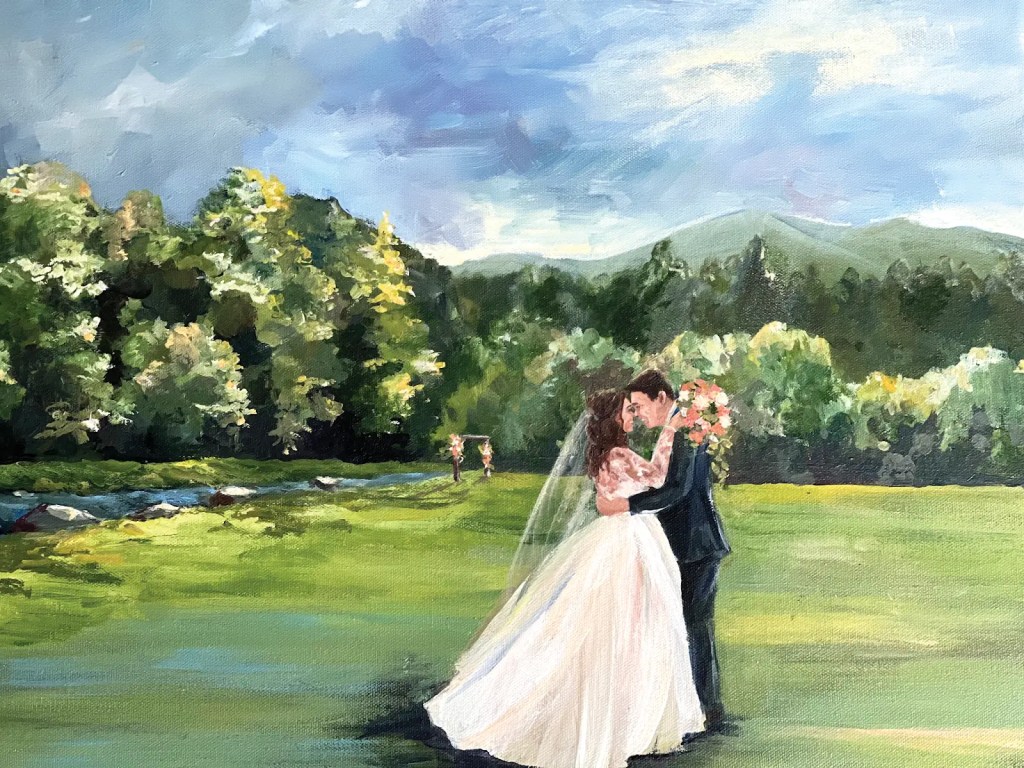
Marriage has been a central idea culturally for thousands of years. From the days of Mesopotamia to the early Modern Era, weddings have been a symbol of social and economic contracts, binding two individuals from respective families.
Although in western culture we don’t view marriage as a contractual alliance anymore, traditions remain prevalent throughout the wedding phenomenon. Think ‘something old, something new, something borrowed, something blue’ – tokens that the Victorians believed brought good luck to the newlyweds. This is where the concept of the live wedding painting emerges; these traditional ceremonial heirlooms.
Live wedding paintings have become a popular trend in the West, gaining traction through social media platforms like TikTok and Instagram. More and more couples are looking for something special that captures their big day, something that can be enjoyed both in the moment and as a keepsake. It provides both entertainment for the guests and newlyweds together, whilst also capturing a personal look into the wedding celebration for the pair. Whilst this may seem like an emerging trend, wedding portraits have been a central part of wedding celebrations since the ancient world.
The Ancient Egyptians were one of the first civilizations to artistically commemorate family unions. The formats varied in this time, but there are a few notable examples. The first is of statue; The Statue of Raherka and Meresankh (c. 2400 BCE). This painted limestone statue (currently displayed in the Louvre) depicts a husband and wife embracing one another, a symbol of their marital union. The Ancient Egyptians also painted murals, often in tombs, to display a couple – these weren’t necessarily depictions of the wedding day, but they do indeed depict a celebrated marriage union.
In more recent times, wedding ceremonies had to be captured prior to the invention of the camera. Artists were often commissioned to sketch or paint unions such as these, particularly by the wealthy. For example, during the Renaissance period, aristocrats and royalty were able to commission portraits for their wedding ceremony that allowed them to have this similar heirloom. Many well known artists during this period e.g. Jan Van Eyck, created portraits that celebrated wedding culture, through both portraits of the couple and of symbolic wedding objects. A popular example of this is Jan Van Eyck’s Arnolfini Wedding or Giovanni Arnolfini and His Bride.
With the invention of more portable materials, during the 18th century it became more possible to have an artist paint during the celebrations. During the Victorian era, artists commonly attended large social gatherings (though not commonly wedding celebrations), and painted live, further refining commissioned pieces later. However, these were not the same as our modern live wedding paintings – the Victorians didn’t have access to the modern tools needed to create a live portrait and artists of the time focused more on studio work and larger commissioned pieces. The Impressionist movement, however, influenced artists to paint outdoor natural landscapes spontaneously, perhaps influencing this later trend. Theodore Robinson’s The Wedding March is a wonderful example of a wedding painting captured in this Impressionist style.
With the introduction of photography, portrait painting became less and less common. The creation of affordable cameras like the Kodak Brownie, allowed for photography to become accessible to a wider audience, meaning that people from lower class backgrounds could also capture their celebrations. This really impacted the concept of commissioned paintings, something still reserved for the wealthier classes. During the 1960s, an artistic movement emerged that used the body as the primary medium of art. Some artists engaged in action painting, which allowed for the act of painting itself to be seen as part of the performance. A famous example of an action painter is Jackson Pollock; he often placed his canvas on the floor and painted from there.
The now-known concept of ‘Live Wedding Painting’ emerged during the late 90s to early 2000s. It was frequented in luxury weddings, creating a completely unique experience for guests and a priceless heirloom for the newlyweds. The idea of live wedding paintings seems to derive from commissioned portraits, symbolic of both wealth and class. Although TikTok’s popularisation of painters such as Maggie Smith Kühn (@watchmaggiepaint) and Nicolette Martin (@nicmartin_event) have made the process of live wedding paintings more accessible, it is still a luxury wedding item. The pricing varies from painter to painter, but live paintings can vary from a price of £800 for smaller pieces and £3000 for larger, detailed pieces. Of course, experience can affect this pricing too!
With TikTok’s amplification of the live wedding painting movement, the experience has become a much-wanted element of the wedding celebrations for many. Its popularity has risen greatly and is becoming more and more of a widespread phenomenon in the West. But with this popularity, there is a rise in price (and a rise from an already luxurious expense!). It is an investment, and one that could see a continued rise throughout this period of publicity.
 Surround Sound Magazine
Leave a comment