by Grace Clift
The Barclays Women’s Super League Golden Boot and Golden Glove awards are treasured by those who win them, and vied for by every footballer in the league. Going to the leading goalscorer and the goalkeeper with the most clean sheets, the awards are a highlight of many footballers careers. As well as being symbols, though, they are incredibly detailed pieces of art. I spoke to Diana Pattenden, the sculptor behind the BWSL Golden Boot and Golden Glove awards.
The process to make such delicate work is complicated, and involves an extensive team. WildWest Design was responsible for establishing the design concept and working closely with Barclays over several months, before presenting the approved design to Diana for development.
Spanning across the globe, from the Florida Keys to West Berkshire, my call with Diana was off to a good start simply by connecting. Diana called me from her idyllic countryside house in West Berkshire, complete with an art studio in her back garden. She told me she’d been sculpting “all my life”, ever since her mother gave her some dough at five years old. I asked her how she ended up with such an amazing opportunity.
“I was working in Hungerford in a gallery, and a guy came in with his bronzes to exhibit. We became friends and I was making ceramics and he said “You should cast this in bronze”. So I started my work in bronze. And then, when they wanted to have a female sculptor make the trophies for the Barclay’s Women’s Super League, he suggested me to WildWest Design, along with some other incredible sculptors.”
It’s an opportunity that many artists across the world would be desperate for. In terms of sports though, she admits she’s not the sporty type. “I did a bit of hockey, and it’s good to keep fit!” she tells me. But the world of football was new to her when she was made the offer.
“Football has got a tight grip on the world. I think it was the European Championship, that was the year that I had been asked to sculpt the trophy. So, you know, I’ve hardly ever watched football and even when I was being asked to do this project, it was lots of to-ing and fro-ing with [how the design would become sculpture]. [Football boots] are incredibly designed for the lightweight nature of [their activity]. They’re pretty incredible shoes. It needed to be feminine as well and not look like a male boot”.
“I was pretty amazed by the beautiful shapes. It’s like [a] sculpture in itself.”
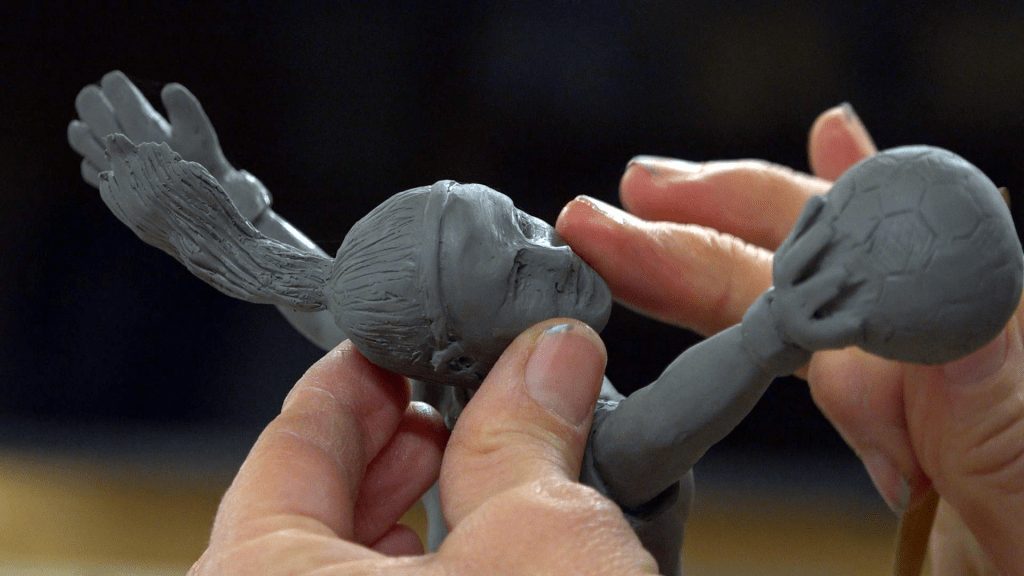
There were difficulties in the process of making the Barclays WSL Golden Glove award. The sculpture shows a goalkeeper reaching for a ball, with the person connecting to the base in a way that had to be carefully considered.
“Giving the balance point for the toe to actually sit upon the solid acrylic base of the trophy was quite tricky, because you don’t want it to bend you know, and what looks good on paper in practicality is a kind of balance point where it could just fall off. You can’t defy gravity, bronze is quite heavy and the acrylic base is lightweight. That’s what we were challenged with, quite a lot of the time, to get it so that it would balance. And also that you couldn’t put a bolt through something that was transparent because it would be visible. So we had quite a lot of technical challenges, but we overcame them and it was so exciting working with WildWest Design.”
Diana was particularly enthralled by the experimentation with texture that came with the experience. To make the BWSL Golden Boot Award have the texture of a boot, she resorted to some unique methods.

“Now I know with some of my sculptures I use the little bag that you get your garlic in, and it’s a kind of stretchy plastic weave. And when you press that into – I use sculptor’s plasticine – it leaves a pattern. And it just so happened that my daughter’s gym shoes actually came in a sort of bag that had this texture. So we use that to press into the surface of the boot, and that’s where it gets its modern techy look about it.”
Once the model is made, there’s a number of processes it must go through to reach the final product.
“Bronze casting itself has got about seven stages to it. So I’m the model maker. I make the original in plasticine.
“And that gets taken to the Foundry. They make a mould of it. And to make a mould of it, they have to cover it in plaster of Paris, leaving a gap to enable rubber to be poured so that the rubber has got a close fit to the original artwork.”
“So you’ve got a plaster support and a rubber glove around the piece. And depending on the sculpture, with the boot, it’s just a two piece mould. And, actually, I think with the Barclays WSL Golden Glove, it was a two piece mould. But some sculptures require several pieces that sit together in a kind of jigsaw puzzle way to get to cater for the undercuts.
“Once you’ve got your rubber mould, you then make a wax version of your original. So you pour wax into the space where your sculpture was and roll it around, so that you get a hollow wax version. Then that item is dipped into some special liquid, which is heat resistant. And it’s dipped several times to build up layers. And then it’s even rolled in some heat resistant sort of dust. And, then once it’s got sufficient layers on it, the whole object is put into a kiln upside down, and all the wax is melted out. So then you’re left with cavity number two”.
“So you’ve had a rubber cavity, and now you’ve got a ceramic cavity into which the bronze is poured. And at the Foundry – it is a magical thing. They pour molten bronze every week, sometimes several times a week, heating up the ingots of bronze, which are sitting like bullion on top of the foundry furnace. And then once they get a certain heat, they’re sort of tongued into the crucible. And then the noise of this foundry heating up the metal is phenomenal.”
“Once it’s cool, they lift out this ceramic thing, which has now got the bronze inside it, and they have to chip the ceramic thing away. Then you’ve got this kind of fairly raw piece of your bronze work that needs to go into the metal workshop for fettling. Perhaps there is a little hole that needs welding, and perhaps there’s elements that need to be adjusted. They add on a bit of bronze to [fix it], and it looks perfect then. And so, they just polish it unbelievably, but not losing any of the detail.”
The Barclays Women’s Super League Golden Awards mean so much more than what is on the surface – they are evidence that hard work creates beauty, and the product of attention to detail. The work of Diana Pattenden deserves the celebration of all football fans, as an icon of what happens when you dedicate time and effort to your craft.
 Surround Sound Magazine